
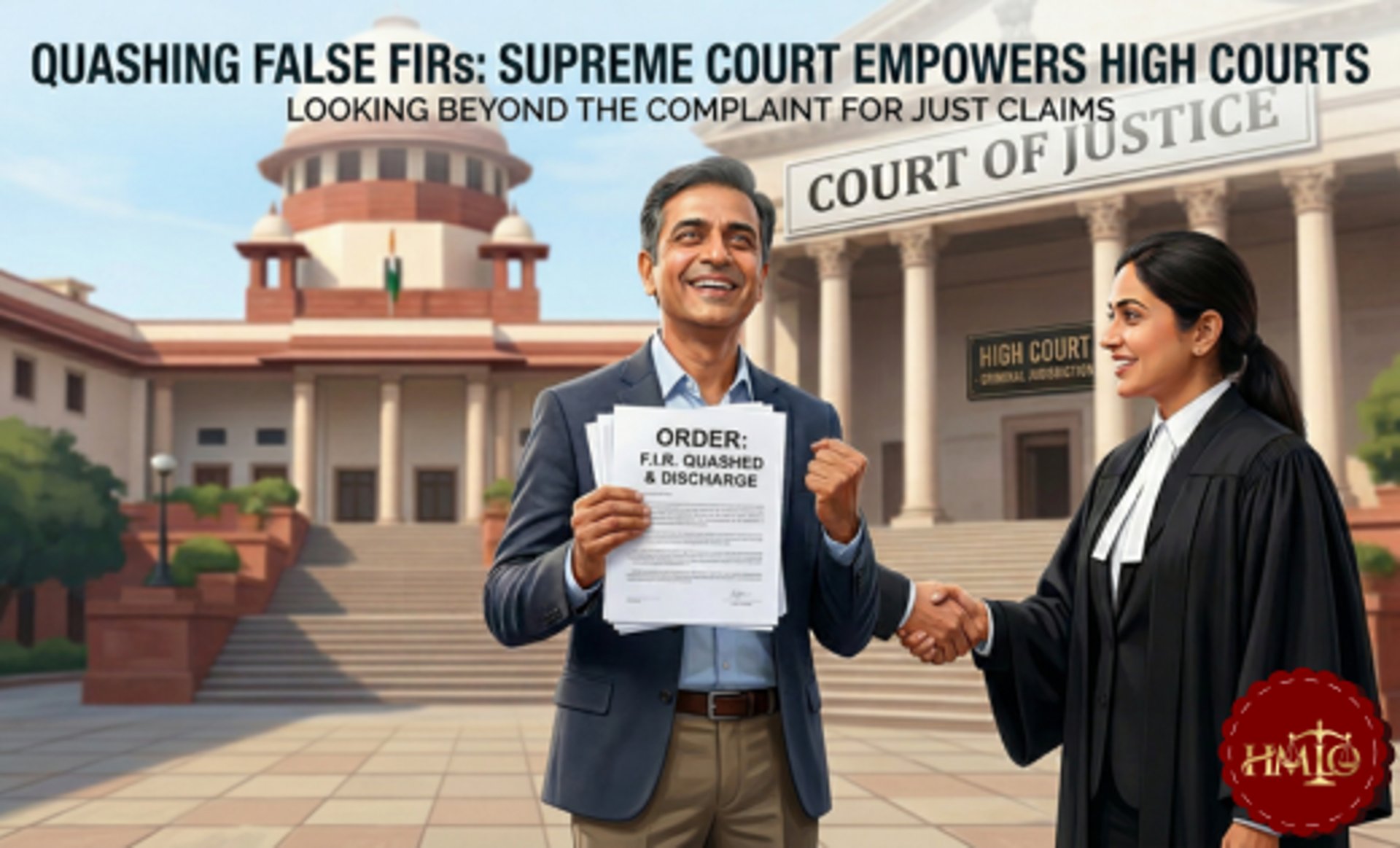
Quashing False FIRs Supreme Court Empowers High Courts to Look Beyond the Complaint
Facing vexatious litigation? Discover how the Supreme Court's 2026 ruling expands High Court powers to examine surrounding evidence and quash frivolous criminal proceedings under Section 482 CrPC.
LITIGATION
Adv. Harsh Malik (Partner, Litigation)
3/22/20263 min read
At Harsh Malik Law Offices, we frequently consult with individuals and corporate clients in our office who are facing the severe stress of baseless criminal charges. A landmark 2026 Supreme Court judgment brings significant relief to victims of malicious prosecution, reaffirming that the inherent powers of the High Court are vast enough to cut through fabricated allegations.
In the case of Sujoy Ghosh v. The State of Jharkhand & Anr., a bench comprising Justices P.S. Narasimha and Alok Aradhe clarified the scope of the High Courts' power to quash criminal proceedings.
Here is a detailed legal analysis of this pivotal ruling and what it means for the quashing of false FIRs under Section 482 of the Criminal Procedure Code (CrPC) and Article 226 of the Constitution.
The Core Legal Issue: Reading Between the Lines of Frivolous Complaints
Historically, a common hurdle in quashing criminal proceedings at the summoning or pre-trial stage has been the argument that courts should only look at the face of the FIR or complaint. If the basic ingredients of an offense are mentioned—no matter how absurd—lower courts often issue summons, arguing that the veracity of the claims must be tested during the trial.
The Supreme Court has firmly pushed back against this limited approach when dealing with manifestly frivolous, vexatious, or malicious proceedings. The Court emphasized that it is not enough to merely look at the averments made in the FIR or complaint.
The Supreme Court's Observation on High Court Powers
Relying on established precedents, including the Mohd. Wajid & Anr. case, the Supreme Court made profound observations regarding the duty of the courts:
Duty to Examine Attending Circumstances: In cases of vexatious litigation, the Court owes a duty to look into attending circumstances emerging from the case record, beyond just the initial averments.
Reading Between the Lines: Courts must act with due care and circumspection, actively trying to "read in between the lines" to uncover the true nature of the prosecution.
Empowered by Section 482 CrPC and Article 226: When exercising jurisdiction under Section 482 of the Code or Article 226 of the Constitution, High Courts need not restrict themselves solely to the current stage of the case.
Assessing Overall Context: Courts are fully empowered to take into account the overall circumstances that led to the initiation and registration of the case, alongside any materials collected during the investigation.
Application to the Facts: The Kahaani-2 Copyright Dispute
The practical application of this law was clearly demonstrated in the facts of the Sujoy Ghosh appeal. The appellant, a renowned film director, faced criminal copyright infringement charges (under Section 63 of the Copyright Act and Section 387 of the IPC) from a complainant claiming the hit film Kahaani-2 was based on his unregistered script.
The Supreme Court noted several fatal flaws in the prosecution that warranted quashing:
Bald Allegations: The complaint contained unsubstantiated claims and failed to identify any specific features or scenes from the script that were allegedly copied.
Concealment of Material Facts: The complainant deliberately hid a crucial expert report from the Screen Writers Association (SWA) Dispute Settlement Committee, which had already found zero similarity between the film and the script.
Mechanical Summoning: The lower court (Chief Judicial Magistrate) passed the summoning order in a mechanical manner without applying its mind to the lack of similarity or the concealed expert report.
Consequently, the Supreme Court set aside the High Court's refusal to intervene, quashed the summoning order, and dismissed the underlying criminal complaint.
Key Takeaways for Litigants
For those battling false FIRs, this judgment serves as a powerful shield:
Pre-Trial Relief is Possible: You do not necessarily have to endure a grueling trial if the case against you is demonstrably malicious.
Evidence Matters Early: High Courts can and should consider investigative materials, expert reports, and the overall context—not just the complainant's isolated statement—when deciding a Section 482 petition.
Concealment is Fatal: If a complainant hides material facts (like prior settlements, contradictory reports, or civil disputes), it strongly supports grounds for quashing.
Case Title: SUJOY GHOSH VERSUS THE STATE OF JHARKHAND & ANR.
About the Author
Harsh Malik | Advocate & Founder
Harsh Malik is an Advocate and the Founder & Designated Partner of Harsh Malik Law Offices LLP (HMLO). With a robust practice spanning criminal litigation, corporate law, and strategic business advisory, he is dedicated to defending his clients' rights against complex legal challenges. Harsh routinely counsels individuals, entrepreneurs, and businesses on critical legal frameworks, combining sharp legal acumen with practical, result-oriented solutions for both domestic and international clients.
Harsh Malik Law Offices (HMLO)
Secure Your Legal & Financial Future Today.
CONTACT US
ReQUEST A CALLBACK
Email:
Office:
© 2025. All rights reserved. Designed by PC Media House.
Mobile:
QUICK LINKS
Chamber No. 416, Lawyer’s Block, Saket Courts, New Delhi-110017
K-10, Basement, Lajpat Nagar-2, New Delhi-110024
harshmaliklawoffices@gmail.com
+91-9997095444, +91-9997436363