
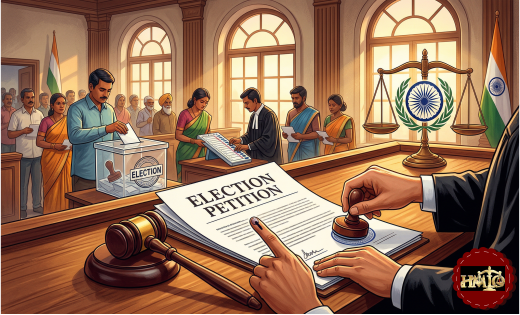
Supreme Court: Election Petition Must Be Decided on Record, Not Remanded to Fill Evidence Gaps | Harsh Malik Law Offices
The Supreme Court of India ruled in Rakam Singh vs Amit & Ors that election petitions must be decided on existing evidence. No remand to fill evidentiary gaps. Expert analysis by Harsh Malik Law Offices, New Delhi.
LITIGATION
Adv. Harsh Malik (Founding Partner, Litigation)
4/4/20269 min read
Receiving a Show Cause Notice (SCN) from the Enforcement Directorate, Income Tax Department, SEBI, or any regulatory body can be deeply unsettling. The instinct of most individuals and businesses is to wait, respond, and challenge only after a final order is passed. But what if the notice itself is legally invalid? A watershed Supreme Court ruling in 2026 clarifies exactly when — and how — such a notice can be challenged upfront in court.
In a significant ruling that reinforces the integrity of India's democratic process, the Supreme Court of India has categorically held that an election petition must be decided based solely on the materials available on the existing record. Appellate courts cannot remand election petitions back to lower forums merely to allow fresh evidence to be gathered, new witnesses to be called, or expert examinations to be conducted — especially when such issues were never raised before the original Election Tribunal.
The judgment — delivered in Rakam Singh vs Amit & Ors. — sets a firm procedural boundary that has far-reaching implications for how election disputes are fought, decided, and appealed across India. At Harsh Malik Law Offices (HMLO), our team of experienced election law litigators has closely analysed this ruling to help you understand what it means, how it changes the legal landscape, and what it demands from anyone filing or defending an election petition.
Case at a Glance
Rakam Singh vs Amit & Ors.
COURT:
Supreme Court of India
BENCH:
Justice Vikram Nath & Justice Sandeep Mehta
ISSUE:
Double voting in Sarpanch election; validity of remand by High Court
KEY HOLDING:
Election petitions must be decided on existing record; no remand permitted to fill evidentiary gaps
OUTCOME:
Writ restored; High Court directed to decide on merits from existing evidentiary record
FOR PETITIONER:
Mr. Karan Kapoor, Mr. Manik Kapoor, Ms. Srishti Singla, Mr. Shrey Kapoor (AOR)
Background: What Led to This Landmark Ruling?
The case originated at the grassroots level of Indian democracy — a village panchayat election for the post of Sarpanch. The appellant, Rakam Singh, challenged the election of the respondent Amit, alleging that the respondent had engaged in double voting — a serious electoral malpractice where a person votes more than once, thereby corrupting the integrity of the electoral process.
The case traversed through multiple levels of the judicial hierarchy, and each stage produced a different outcome, ultimately raising a fundamental legal question before the Supreme Court about the procedural boundaries of appellate review in election matters.
The Proceedings: A Step-by-Step Journey
Trial Court / Election Tribunal
Election Set Aside — Appellant Succeeds
The Trial Court found merit in Rakam Singh's allegation of double voting. Finding sufficient material on record, the Election Tribunal set aside Amit's election to the Sarpanch post — a clear win for the petitioner.
First Appellate Court
Upheld Trial Court; Ordered Fresh Election
The First Appellate Court upheld the Trial Court's findings and directed a fresh election to be held. The respondent's election remained invalidated at this stage.
High Court (Writ Jurisdiction)
High Court Intervenes — Remands the Case
The High Court, exercising its writ jurisdiction, set aside the First Appellate Court's order. Rather than deciding the matter, the High Court remanded the election petition for fresh consideration. It further directed that voters be called as witnesses and that an expert fingerprint analysis of thumb impressions on voter lists be obtained — evidence and processes that were never part of the original record or arguments before the Election Tribunal.
Supreme Court of India
Supreme Court Corrects — Principles Laid Down
The Supreme Court found the High Court's approach to be legally impermissible. It set aside the remand order and restored the writ petition, directing the High Court to decide the matter on merits based solely on the existing evidentiary record.
The Supreme Court's Ruling: What the Court Said
The bench of Justice Vikram Nath and Justice Sandeep Mehta made it unambiguous: once an election petition reaches the appellate stage, the court's role is to decide the case on the basis of what has already been placed on record. The appellate forum — whether a First Appellate Court or a High Court in writ jurisdiction — cannot become a mechanism for any party to shore up evidentiary deficiencies after the fact.
It is impermissible for the Appellate Court to remand election petitions for reconsideration merely to lead to fresh evidence or direct the calling of witnesses and expert examination when such issues were not raised before the Election Tribunal.
— Supreme Court of India, Rakam Singh vs Amit & Ors., 2025
The Core Verdict
An election petition must be decided on the materials on record. It cannot be remanded to an Election Tribunal to fill evidentiary gaps or to lead fresh evidence on issues never raised before the original forum.
The Court's reasoning is rooted in both principle and practicality. Election disputes carry a uniquely compressed timeline — a delayed or inconclusive resolution undermines democratic governance. More fundamentally, allowing remand to gather fresh evidence rewards parties for evidentiary lapses at the original stage, which goes against basic principles of fair adjudication.
By restoring the writ petition and directing the High Court to decide it on merits from the existing record, the Supreme Court effectively ensured that the petitioner's original success before the Trial Court would be assessed fairly, without the respondent getting a second opportunity to manufacture an evidence trail.
Key Legal Principles Established
This ruling establishes and reinforces several important legal principles that every election petitioner, respondent, and legal practitioner in India must internalise:
01
Finality of Evidence at Trial Stage
All evidence must be led before the Election Tribunal. Appellate forums are not a second chance to build a case. What is on record is what courts must decide on.
02
Prohibition on Evidentiary Remands
A remand solely to collect fresh evidence, call new witnesses, or conduct expert examinations is impermissible in election petition proceedings at the appellate level.
03
Appellate Court's Duty to Decide
When jurisdiction is exercised over an election petition, the court must adjudicate the case on merits. Avoiding a decision by remanding the matter is not a valid exercise of appellate power in election law.
04
Limitation on High Court's Writ Powers
Even in writ jurisdiction, a High Court cannot direct procedures (such as calling expert witnesses) that were never part of the original petition or trial, in order to remedy evidentiary gaps.
Why This Judgment Matters: The Broader Significance
India conducts elections at every level — from the Lok Sabha and Rajya Sabha to State Assemblies, Municipal Corporations, and Panchayats. Tens of thousands of election petitions are filed across the country every electoral cycle. This judgment by the Supreme Court directly impacts how all of these disputes will be handled.
Double Voting: A Serious Electoral Malpractice
The facts of this case also bring into focus the issue of double voting — where the same person votes more than once using duplicate or fraudulent entries in the electoral roll. This is an offence under Indian election law and a valid ground for filing an election petition to challenge the result. The Supreme Court's affirmation that such allegations must be rigorously examined — and that the original record is sufficient for this purpose — is an important signal to Election Tribunals to conduct thorough proceedings in the first instance.
The emphasis on thumb impression analysis in this case also highlights the forensic dimensions of modern election disputes. While the Supreme Court did not endorse the High Court's direction to call for expert fingerprint examination at the appellate stage, the ruling underscores the importance of proactively securing such forensic evidence at the trial stage if it is relevant to one's case.
Faster Resolution
Prohibiting evidentiary remands means election petitions will be decided more swiftly, reducing the legal limbo that affects elected offices.
Better Case Preparation
Petitioners and respondents must now ensure that all necessary evidence is placed on record at the very first stage before the Election Tribunal.
Democratic Certainty
The ruling brings greater certainty to electoral outcomes, ensuring that disputes are resolved rather than prolonged through procedural manoeuvring.
What This Means for Lawyers and Litigants Filing Election Petitions
For Petitioners (Those Challenging an Election)
If you are challenging an election, this ruling is both a caution and an opportunity. The caution: every single piece of evidence must be placed on record before the Election Tribunal. The opportunity: if the Tribunal rules in your favour, subsequent appellate courts cannot allow the other side to introduce fresh evidence to undo that verdict.
Practically, this means your legal team must conduct thorough pre-litigation investigation — gathering voter lists, scrutinising thumb impressions if relevant, collecting affidavits from eye-witnesses to voting irregularities, securing copies of Form 7B, EPIC data, and any other electoral documents before filing or during the trial stage.
For Respondents (Those Defending an Election)
If you are defending your election against a petition, this judgment cuts both ways. You cannot rely on the appellate stage to supplement your case with expert evidence you failed to produce at the trial stage. Your defence must be comprehensive and complete when you first appear before the Election Tribunal.
However, this ruling also means that if the Tribunal decides against you, an appellate court reviewing the matter cannot introduce new evidentiary angles to further undermine your position — the appellate court is bound to the record as it stands.
For Appellate Practitioners
Advocates appearing in election matters before High Courts or the Supreme Court must now be extremely precise in framing their arguments within the existing evidentiary record. Grounds of appeal must be strictly linked to what was argued and evidenced before the Election Tribunal. Any attempt to import new facts or request expert examination at the appellate stage is now clearly impermissible following this ruling.
How Harsh Malik Law Offices Can Help You in Election Disputes
Election law is a specialised, time-sensitive, and highly technical area of Indian jurisprudence. Filing an election petition — or defending against one — requires not just knowledge of the Representation of the People Act, 1951 and relevant state legislation, but also a precise understanding of procedural rules, evidentiary requirements, and the rapidly evolving landscape of Supreme Court judgments like this one.
At HMLO, we provide end-to-end legal support for election-related matters, including:
Filing election petitions at the appropriate Tribunal with complete evidentiary support from Day 1
Defending election petitions with a watertight strategy before Election Tribunals
Appellate representation before High Courts and the Supreme Court of India
Pre-litigation advisory on whether an election is legally challengeable and what evidence you will need
Forensic evidence strategy including working with handwriting experts, electoral roll analysis, and documentary forensics
Urgent interim relief applications where democratic rights require immediate court intervention
Given the Supreme Court's ruling that all evidence must be on record at the trial stage, early and thorough legal engagement is now more important than ever. Do not wait until an appellate stage to identify the gaps in your case — by then, it may be too late.
Harsh Malik Law Offices (HMLO) is a premier multi-disciplinary litigation firm headquartered in New Delhi, with practice across the Supreme Court of India, Delhi High Court, Saket District Courts, and Tribunals nationwide. Our team combines rigorous legal expertise with deep strategic insight — ensuring that our clients' cases are built on an unshakeable evidentiary foundation from the very first stage of proceedings.
Frequently Asked Questions (FAQs)
What is an election petition in India?
An election petition is a legal challenge filed by a candidate or elector before the appropriate Election Tribunal, questioning the validity of an election on grounds such as electoral malpractice, bribery, corruption, double voting, or violation of election law. It is governed primarily by the Representation of the People Act, 1951, and relevant state Panchayati Raj Acts for local elections.
Can new evidence be introduced in an election appeal after the Trial Court verdict?
No. Following the Supreme Court's ruling in Rakam Singh vs Amit (2025), an appellate court — including a High Court in writ jurisdiction — cannot permit fresh evidence to be led, new witnesses to be called, or expert examinations to be conducted in election petition proceedings at the appellate stage, especially where such issues were not raised before the original Election Tribunal.
What is double voting and is it a ground for election petition?
Double voting refers to a person casting more than one vote in the same election — a serious electoral offence under Indian law. Yes, it is a valid and recognised ground for filing an election petition to challenge the result of an election, and courts take it very seriously when proved on record.
What should I do immediately if I want to challenge an election result?
Consult an experienced election law advocate immediately. Election petitions are time-bound — the law prescribes strict limitation periods within which a petition must be filed after the result is declared. An early consultation with Harsh Malik Law Offices will help you assess the grounds, gather the right evidence, and file the petition within time.
Can Harsh Malik Law Offices represent me in Supreme Court election cases?
Yes. HMLO has experience in representing clients before the Supreme Court of India. Our founder and designated partner Harsh Malik and our senior litigation team are equipped to handle election petition matters at all levels — Trial Courts, First Appellate Courts, High Courts, and the Supreme Court of India.
Where is Harsh Malik Law Offices located?
HMLO has two locations in New Delhi: Chamber No. 416, Lawyer's Block, Saket Courts Complex, New Delhi – 110017; and K-10, Basement, Lajpat Nagar-2, New Delhi – 110024. We serve clients across India.
Conclusion: A Ruling That Strengthens Democratic Adjudication
The Supreme Court's judgment in Rakam Singh vs Amit & Ors. is a powerful affirmation of the principle that election disputes must be resolved decisively, fairly, and on the basis of evidence that was produced before the original Tribunal. By barring appellate remands to fill evidentiary gaps, the Court has:
Protected the sanctity of original Trial Court proceedings in election matters
Prevented appellate courts from being used as platforms for post-hoc evidence gathering
Imposed a higher duty of diligence on parties and their counsel at the trial stage
Expedited the resolution of election disputes, which is vital for democratic governance
For litigants across India — whether at the Panchayat, Municipal, State Assembly, or Parliamentary level — this ruling is a call to ensure that your election petition is backed by complete and compelling evidence from the outset. The best time to build a winning election case is before you file, not after you lose at the appellate stage.
Harsh Malik Law Offices (HMLO) stands ready to guide you through every stage of this process — with the legal mastery and strategic precision that complex election disputes demand.
This Ruling — Quick Facts
Case: Rakam Singh vs. Amit & Ors.
Citation: 2026 LiveLaw (SC) 318
Bench: Justice Vikram Nath & Justice Sandeep Mehta
Need an Election Law Expert?
Time-sensitive. Evidence-critical. Let HMLO's experienced litigators build your case from Day 1.
About the Author
Harsh Malik | Advocate & Founder
Harsh Malik is an Advocate and the Founder & Designated Partner of Harsh Malik Law Offices LLP (HMLO). With a robust practice spanning criminal litigation, corporate law, and strategic business advisory, he is dedicated to defending his clients' rights against complex legal challenges. Harsh routinely counsels individuals, entrepreneurs, and businesses on critical legal frameworks, combining sharp legal acumen with practical, result-oriented solutions for both domestic and international clients.
QUICK LINKS
CONTACT US
REQUEST A CALLBACK
Secure Your Legal & Financial Future Today.
Harsh Malik Law Offices (HMLO)
© 2025. All rights reserved. Designed by PC Media House.
Office:
Email:
Mobile:
Chamber No. 416, Lawyer’s Block, Saket Courts, New Delhi-110017
K-10, Basement, Lajpat Nagar-2, New Delhi-110024
harshmaliklawoffices@gmail.com
+91-9997095444, +91-9997436363