
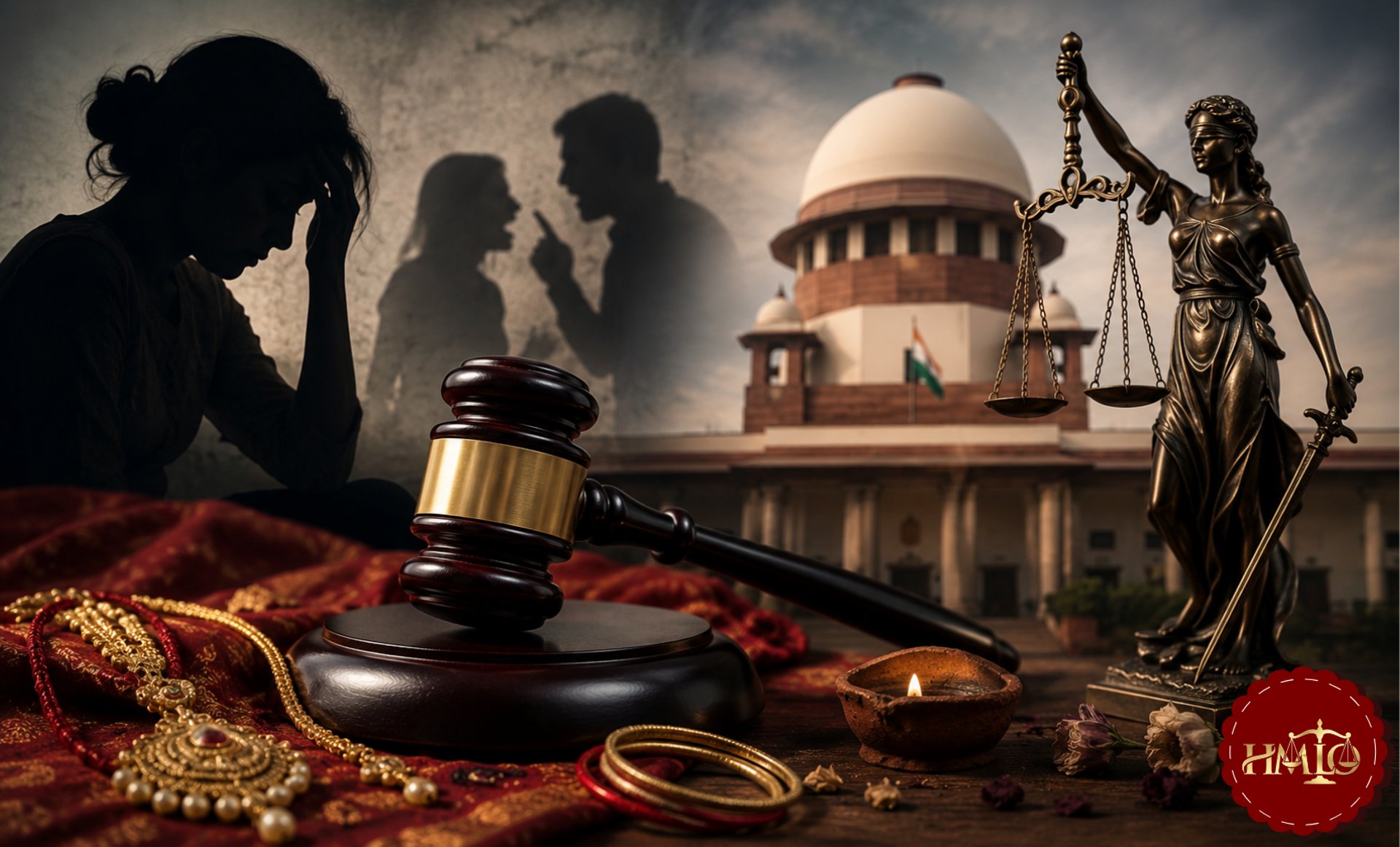
Dowry Deaths in India: How the Supreme Court Has Repeatedly Raised Concerns Over a Menace That Refuses to Die
From Twisha Sharma to Deepika Nagar, the Supreme Court of India continues to confront the persistent dowry death crisis. Understand Section 304B IPC, Section 113B Evidence Act, bail principles, and your legal remedies. Expert analysis by Harsh Malik Law Offices, New Delhi.
LITIGATION
Adv. Harsh Malik (Founding Partner, Litigation)
6/25/20269 min read
Decades after India first legislated against the practice, dowry continues to claim lives across the country — and the Supreme Court of India has found itself, time and again, confronting the same grim reality: a young woman dead within years of her marriage, allegations of cruelty and harassment over dowry demands, and a criminal justice system struggling to deliver swift, certain justice.
From the suo motu intervention in the death of Twisha Sharma in Bhopal, to the brutal case of Deepika Nagar in Greater Noida, to a string of bail orders set aside by the Court for failing to apply the correct legal standard — the message from India's apex court has been consistent and increasingly urgent: the dowry menace is far from over, and courts at every level must treat it with the seriousness the law demands. At Harsh Malik Law Offices (HMLO), we examine this pattern of judicial concern, the legal framework governing dowry deaths, and what families and individuals need to know when facing such a tragedy.
A Pattern, Not an Isolated Tragedy
What makes the Supreme Court's recent interventions especially significant is that they are not isolated responses to a single case — they reflect a pattern of repeated, urgent judicial concern over a social menace that continues to claim young lives across India, including among educated, financially independent, and professionally successful women.
The Court has observed that dowry-related violence remains deeply entrenched despite increased access to education and economic independence for women. Crucially, it has noted that dowry demands are not always explicit before marriage — they often escalate after the matrimonial alliance is formalised, leading to sustained harassment, coercion, and, in the most extreme cases, death. Available data continues to show that thousands of dowry deaths are reported annually across the country, with a significant concentration in certain states, alongside a substantial backlog of pending prosecutions under the Dowry Prohibition Act, 1961 — pointing to systemic challenges in both deterrence and enforcement.
Recent Cases That Forced the Supreme Court's Hand
Note on sub judice matters: Both the Twisha Sharma and Deepika Nagar cases remain under active investigation and judicial proceedings at the time of writing. The accused in both matters are presumed innocent unless and until proven guilty. The facts referenced above reflect allegations and findings reported in the public domain and are not a final adjudication of guilt.
Bhopal, Madhya Pradesh
The Twisha Sharma Case
A 33-year-old corporate professional and former model, Twisha Sharma, died an unnatural death at her matrimonial home in Bhopal on May 12, 2026 — barely five months after her December 2025 marriage. Her family alleged sustained dowry-related harassment. The Supreme Court took suo motu cognisance of allegations of institutional bias and procedural lapses — significant given that the accused mother-in-law was herself a former District Judge — and ordered the matter transferred to the CBI for an independent investigation.
Greater Noida, Uttar Pradesh
The Deepika Nagar Case
24-year-old Deepika Nagar died after allegedly falling from the terrace of her three-storey matrimonial home in May 2026, less than two years after a wedding on which her family says they spent nearly ₹1 crore. Her family alleged her in-laws continued to demand a luxury vehicle and ₹45–50 lakh in cash, and that she was assaulted hours before her death. The post-mortem revealed multiple severe internal injuries — including a ruptured spleen, liver and kidney, and brain haemorrhage — that investigators say are consistent with harassment before death.
When Bail Orders Go Wrong: The Ghaziabad Case
Beyond the high-profile cases dominating headlines, the Supreme Court has also intervened decisively in matters where lower courts have granted bail without adequately weighing the gravity of dowry death allegations — sending a clear signal about the standard of scrutiny required.
In a case arising from the death of a young woman in Ghaziabad in July 2024 — within a few years of her marriage — her father had lodged an FIR alleging continuous harassment and unlawful dowry demands, including for a luxury vehicle and additional cash. After a charge sheet was filed against the husband and his parents, the trial court rejected bail, but the High Court granted it, relying on a medical opinion indicating death by hanging and citing an alleged delay in FIR registration.
Setting aside the Allahabad High Court's bail order, a bench of Justice J.B. Pardiwala and Justice Vijay Bishnoi directed the accused husband to surrender before jail authorities, allowing an appeal filed by the deceased woman's father. The Court specifically flagged its concern over rising dowry deaths in Uttar Pradesh, Bihar, and Karnataka.
The Supreme Court's Correction
The Supreme Court found this reasoning legally flawed — the FIR had in fact been lodged promptly the very next day, with no material delay. The High Court had also failed to properly weigh the post-mortem findings and other material pointing to a prima facie case of dowry-related harassment and unnatural death.
"Courts dealing with bail applications in offences against women, particularly dowry deaths, must exercise heightened judicial scrutiny so that such orders do not undermine public confidence in the criminal justice system or dilute the deterrent effect of the law."
— Supreme Court of India | Bench of Justice J.B. Pardiwala & Justice Vijay Bishnoi
The Legal Framework: How Indian Law Defines and Punishes Dowry Death
Understanding why the Supreme Court keeps returning to this issue requires understanding the specific statutory architecture Parliament has built to combat dowry deaths — and why courts believe that architecture is being inconsistently applied.
Why "soon before her death" matters: Courts have long held that this is an elastic phrase that can mean anywhere from immediately before death to a few weeks prior — but the law requires a perceptible nexus between the dowry-related cruelty and the death itself. If too much time has elapsed between the harassment and the death, courts may find the connection too remote to sustain a Section 304B conviction. This is precisely why prompt FIR registration and thorough evidence-gathering are so critical in these cases.
Why the Statutory Presumption Matters So Much
The presumption under Section 113B (now Section 118 BSA) is one of the most powerful tools available in dowry death prosecutions — and one of the most frequently litigated. Once the foundational facts are established (unnatural death within 7 years of marriage, plus evidence of dowry-related cruelty or harassment soon before death), the burden shifts: it is now for the accused to rebut the presumption, rather than for the prosecution to prove guilt from a neutral starting point.
This reversal of the ordinary burden of proof reflects Parliament's recognition that dowry deaths typically occur within the four walls of a matrimonial home, where direct eyewitness evidence is rare and victims are often silenced long before their deaths. The Supreme Court's repeated insistence that bail courts properly account for this presumption — rather than granting bail on tangential grounds like alleged FIR delays or medical technicalities — reflects its concern that lower courts are sometimes diluting a protection Parliament specifically built into the law.
Key Principles Emerging From the Supreme Court's Interventions
01
Heightened Scrutiny at the Bail Stage
Courts must undertake a careful prima facie assessment of allegations, the statutory presumption, and surrounding evidence — not a mechanical or superficial review — before granting bail in dowry death cases.
02
Education & Economic Independence Don't Eliminate Risk
The Court has explicitly recognised that dowry-related violence persists even among educated, professionally successful women — dismantling any assumption that the menace is confined to less empowered demographics.
03
Suo Motu Powers as a Last Resort Safeguard
Where institutional bias or procedural irregularities are suspected — particularly in cases involving influential or legally connected accused — the Supreme Court has shown willingness to take up matters on its own motion to ensure independent investigation.
04
Deterrence Depends on Consistent Enforcement
The Court has cautioned that casual bail orders or weak prosecutions dilute the deterrent effect of dowry death laws, undermining public confidence in the justice system as a whole.
What This Means in Practice
For Families of Dowry Death Victims
If you have lost a loved one in circumstances suggesting dowry-related harassment, the law provides significant protections — but timely, well-documented action is critical. Prompt FIR registration, preservation of evidence (including the woman's communications, medical records, and witness statements regarding harassment), and engaging experienced legal counsel early can make a decisive difference in whether the statutory presumption is properly invoked and whether bail is appropriately opposed.
For Those Accused in Dowry-Related Cases
The seriousness with which courts are now treating these matters means that individuals facing dowry death or harassment allegations require skilled, vigilant legal representation. The statutory presumption is rebuttable — but rebutting it requires a carefully constructed defence built on the specific facts, medical evidence, and the actual sequence of events, not generic denials.
For the Broader Legal System
These repeated interventions are also a signal to Trial Courts and High Courts across India: bail decisions in dowry death cases must reflect genuine, fact-specific engagement with the statutory presumption and the gravity of the allegations — not reliance on convenient but legally insufficient grounds.
How Harsh Malik Law Offices Can Help You
Dowry death and dowry harassment cases demand a combination of legal precision, emotional sensitivity, and aggressive advocacy. At HMLO, we provide comprehensive support, including:
Filing and pursuing FIRs in cases of dowry harassment, cruelty, and suspected dowry death
Representing families in seeking CBI, SIT, or other independent investigations where institutional bias is a concern
Opposing bail applications of accused persons in dowry death cases, ensuring courts properly apply the statutory presumption
Defending individuals wrongly implicated in dowry-related cases, ensuring a fair and rigorous defence within the bounds of law
Appellate representation before High Courts and the Supreme Court in matrimonial and criminal matters
Civil remedies related to dowry recovery, matrimonial property disputes, and maintenance claims
Whether you are seeking justice for a loved one, or require a fair and rigorous defence against allegations you believe to be unfounded, HMLO is equipped to provide the strategic, sensitive, and determined representation your case demands.
Harsh Malik Law Offices (HMLO) is a premier litigation firm based in New Delhi, with practice before the Supreme Court of India, Delhi High Court, Saket Courts, and Trial Courts nationwide. Our team brings deep expertise in criminal law, matrimonial disputes, and women's rights litigation.
Frequently Asked Questions (FAQs)
What is a dowry death under Indian law?
Under Section 304B of the Indian Penal Code (now mirrored in the Bharatiya Nyaya Sanhita, 2023), a dowry death occurs when a woman dies of burns, bodily injury, or under otherwise unnatural circumstances within seven years of her marriage, and it is shown that soon before her death she was subjected to cruelty or harassment by her husband or his relatives in connection with a demand for dowry.
What is the legal presumption applicable in dowry death cases?
Under Section 113B of the Indian Evidence Act, 1872 (now Section 118 of the Bharatiya Sakshya Adhiniyam, 2023), once it is shown that a woman died an unnatural death within seven years of marriage and was subjected to cruelty or harassment for dowry soon before her death, the court presumes that the accused caused the dowry death. This shifts the burden onto the accused to rebut the presumption with evidence.
Why has the Supreme Court repeatedly intervened in dowry death cases?
The Supreme Court has intervened repeatedly because dowry-related violence remains deeply entrenched in India despite decades of legislation, with thousands of dowry deaths reported annually and a significant backlog of pending prosecutions under the Dowry Prohibition Act, 1961. The Court has used its suo motu powers, set aside unsustainable bail orders, and emphasised heightened judicial scrutiny to address what it considers a continuing systemic failure of deterrence and enforcement.
What should I do if I suspect a family member is facing dowry harassment?
Document any instances of harassment, demands, or threats — including messages, witness accounts, and medical records if there has been physical harm. File a complaint with the police promptly; delay can weaken the case and is often exploited by the defence. Consult an experienced criminal lawyer immediately to understand your legal options, including filing an FIR under Sections 498A and, where applicable, pursuing protective remedies.
What should courts consider while deciding bail applications in dowry death cases?
Courts must undertake a prima facie assessment of the allegations, the nature and gravity of the offence, the statutory presumption under Section 113B of the Evidence Act (or Section 118 of the Bharatiya Sakshya Adhiniyam), and the surrounding circumstances including medical and post-mortem evidence, before granting bail. The Supreme Court has cautioned that casual or premature bail orders in such cases can undermine public confidence in the criminal justice system.
Conclusion: A Menace the Law Continues to Confront
The Supreme Court's repeated, urgent engagement with dowry death cases — from suo motu interventions in high-profile deaths to course-correcting unsustainable bail orders — reflects a sobering truth: more than six decades after the Dowry Prohibition Act, 1961 was enacted, and more than four decades after Section 304B was inserted into the Indian Penal Code, dowry continues to claim the lives of Indian women, cutting across education, profession, and social class.
What emerges from this pattern of judicial concern is not despair, but a renewed institutional resolve. The Supreme Court has made clear that statutory presumptions exist for a reason, that bail decisions cannot be casual in matters of this gravity, and that institutional bias — wherever it arises — will not be permitted to obstruct justice. For families seeking justice, and for the broader legal community, this consistent judicial vigilance is a vital safeguard. But as the Court itself has recognised, legal remedies alone cannot fully address a deeply entrenched social menace — sustained societal change remains equally essential.
Facing a Dowry-Related Case?
Whether seeking justice or a fair defence, HMLO provides experienced, sensitive legal representation.
Related Reads
About the Author
Harsh Malik | Advocate & Founder
Harsh Malik is an Advocate and the Founder & Designated Partner of Harsh Malik Law Offices LLP (HMLO). With a robust practice spanning criminal litigation, corporate law, and strategic business advisory, he is dedicated to defending his clients' rights against complex legal challenges. Harsh routinely counsels individuals, entrepreneurs, and businesses on critical legal frameworks, combining sharp legal acumen with practical, result-oriented solutions for both domestic and international clients.
QUICK LINKS
CONTACT US
REQUEST A CALLBACK
Secure Your Legal & Financial Future Today.
Harsh Malik Law Offices (HMLO)
© 2025. All rights reserved. Designed by PC Media House.
Office:
Email:
Mobile:
Chamber No. 416, Lawyer’s Block, Saket Courts, New Delhi-110017
K-10, Basement, Lajpat Nagar-2, New Delhi-110024
harshmaliklawoffices@gmail.com
+91-9997095444, +91-9997436363